

How to Define an “Activation Event” That Predicts Trial-to-Paid Conversion
If your activation definition doesn’t predict revenue, it’s just a metric. Here’s a practical, no-data-science method to identify the event (or event sequence) that best correlates with trial-to-paid conversion, validate it with simple cohort analysis, avoid false signals, and set the right time window for your trial length.
 Isabella W.Growth Analyst
Activation is only useful if it predicts revenue. If your “activated users” don’t convert to paid at a meaningfully higher rate, your activation metric is just a vanity proxy for activity.
This guide shows a practical way to define an activation event (or short sequence) that reliably predicts trial-to-paid conversion—using simple analysis you can do in a spreadsheet or basic product analytics.
What an activation event is (and what it isn’t)
An activation event is a user behavior (or sequence of behaviors) that indicates the user has reached a meaningful “aha” moment—enough value that they’re significantly more likely to become a paying customer.
A good activation event has three properties:
- Value-revealing: It’s tightly connected to the core value your product delivers.
- Early: It happens early enough in the trial to influence conversion (and be influenced by onboarding).
- Predictive: Users who complete it convert at a materially higher rate than those who don’t.
What activation is not:
- Login / sign-up (too shallow)
- Time spent (often correlates with confusion)
- “Used feature X” when feature X is optional or not tied to value
- A checklist completion if the checklist includes low-value steps
Step 1: Start with your conversion goal and unit of analysis
Before you pick events, define two basics:
Your conversion outcome
For trials, the cleanest outcome is typically:
- Converted to paid within N days of trial start
Pick N based on your buying cycle. Common choices:
- 14-day trial → N = 21–30 days
- 30-day trial → N = 45–60 days
This avoids mislabeling late purchasers as “non-converters.”
Your unit of analysis (user vs account)
In B2B SaaS, conversion is usually at the account/workspace level. Activation should often be measured at the same level.
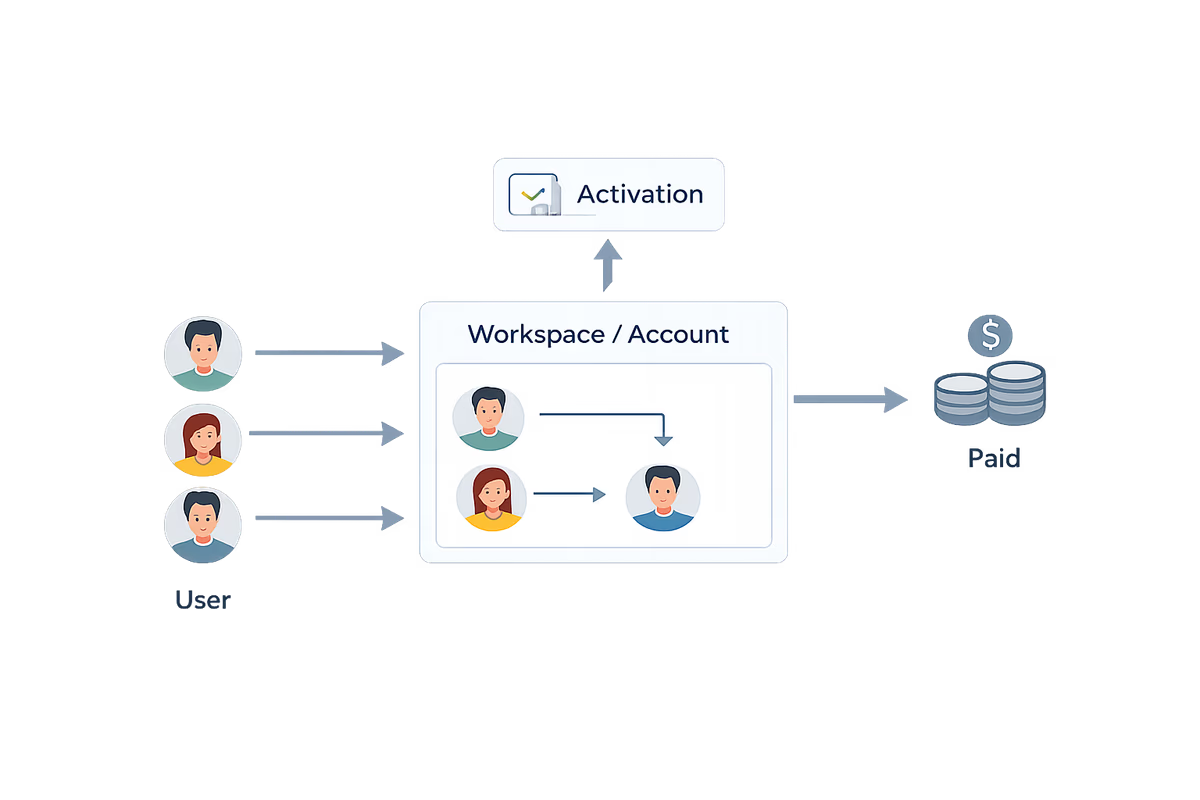
Use:
- Account-level activation if multiple users contribute to value (collaboration, approvals, shared dashboards).
- User-level activation if one person can realize value alone (personal productivity tools).
If you choose account-level, define activation as “at least one user in the account completed the activation event” or “two distinct users completed X,” depending on your product.
Step 2: Shortlist candidate activation events (10–20 max)
Your goal is not to brainstorm endlessly. You want a shortlist of plausible “value moments.”
Where to find candidates
- Sales/CS call notes: What do successful customers say they needed to see before buying?
- Onboarding paths of converted trials: What did they do in the first few days?
- Your product’s value chain: What must be true for the user to experience the outcome?
- Support tickets during trial: What blocks value (and what actions resolve it)?
Candidate event types that work well
- First successful output: exported report, published page, launched campaign, shipped integration
- First data-in moment: imported dataset, connected CRM, installed SDK, synced inbox
- First workflow completion: created → assigned → completed; drafted → approved → sent
- First collaboration moment: invited teammate who becomes active; shared dashboard viewed
- Repeated meaningful use: performed core action 3 times in 7 days
Avoid candidates that are usually false signals
- Visiting settings pages
- Clicking around feature menus
- “Created project” if projects are empty containers
- Watching a tutorial video (good for education, weak as activation)
Step 3: Define each candidate precisely (event + constraints)
Most activation definitions fail because they’re vague. For each candidate, write it as:
Event + object + threshold + time window
Examples:
- “Connected a data source AND successfully imported at least 500 rows within 48 hours of signup.”
- “Created a campaign AND sent at least 1,000 emails within 7 days.”
- “Invited 2 teammates AND at least 1 teammate completed a core action within 7 days.”
Be explicit about what counts as success:
- “Integration connected” should mean authenticated and passing data, not just clicked “Connect.”
- “Report created” should mean saved with at least one filter or chart, not an empty draft.
Step 4: Validate predictiveness with a simple cohort table
You don’t need a data science team to validate activation. You need a clean comparison.
Build a 2x2 table for each candidate
For a cohort of trial starts in a fixed period (e.g., last 60–90 days):
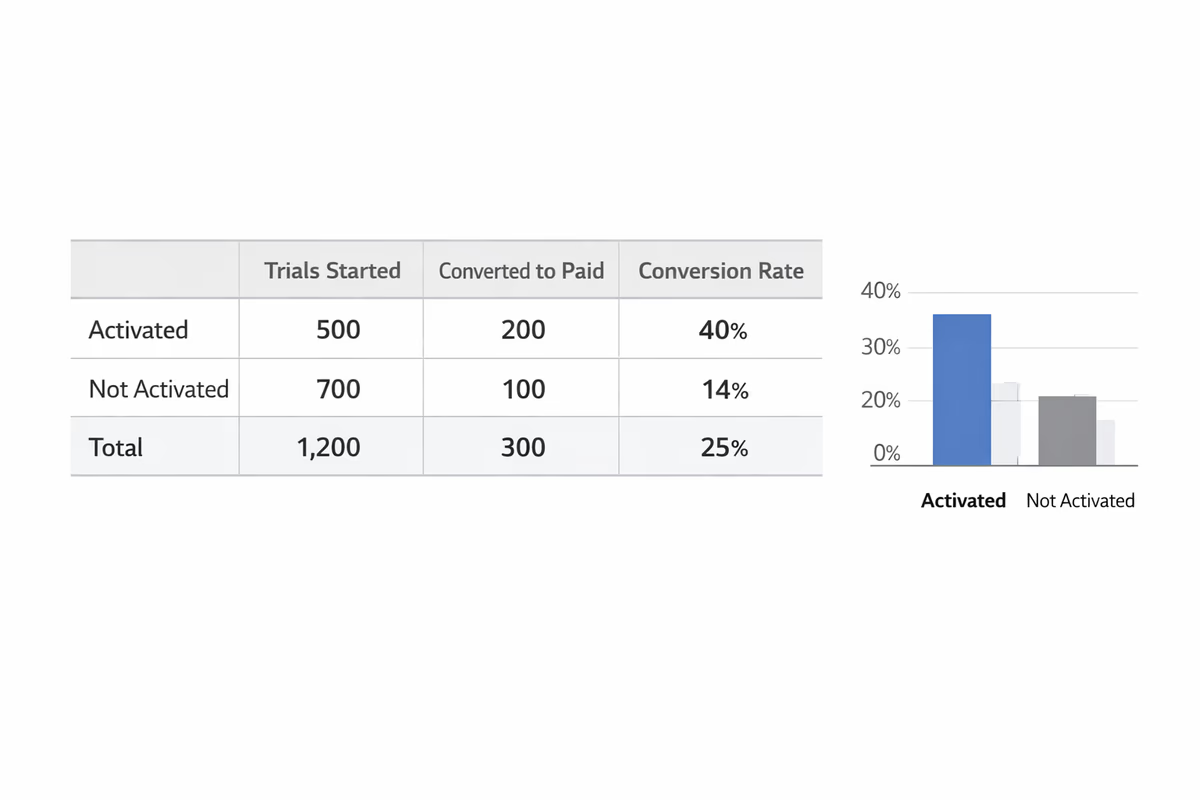
- Group A: accounts that completed candidate event within the window
- Group B: accounts that did not
Compute:
- Conversion rate of Group A
- Conversion rate of Group B
- Lift = (A conversion rate) / (B conversion rate)
What you’re looking for:
- Meaningful separation (often 2x+ lift is a strong starting signal)
- Enough sample size to trust the result
If you have small numbers, widen the cohort time range (e.g., 6 months) or use a slightly broader activation definition.
Add “time-to-event” as a second lens
Activation should happen early. For the same event, calculate:
- Median time from signup to event for converters vs non-converters
If converters do it quickly and non-converters either never do it or do it late, you’re closer to a usable activation definition.
Step 5: Check for false positives (the 4 common traps)
An event can correlate with conversion while still being a bad activation definition.
Trap 1: The event is basically a purchase step
If your “activation event” is “added credit card” or “visited pricing page,” it will predict conversion—but it doesn’t help you design onboarding.
Fix: Move earlier in the journey to the first value moment that leads to purchase intent.
Trap 2: The event is driven by sales-assisted motion
If your sales team guides certain accounts to a setup milestone, that milestone may predict conversion because those accounts were already qualified.
Fix: Segment by motion (self-serve vs sales-assisted) or by lead source, then re-check lift.
Trap 3: The event is too rare
If only 3% of trials reach the event, it might be a great signal but useless as a north-star for onboarding.
Fix: Create a two-tier model:
- Activation (broad): early value milestone that 20–40% can reach
- Power activation (narrow): deeper milestone strongly tied to expansion
Trap 4: The event is too easy
If 80–90% of trials hit it, it won’t separate converters from non-converters.
Fix: Add thresholds (quantity, repetition, success criteria) or make it a short sequence.
Step 6: Decide whether activation should be a single event or a sequence
Many B2B products don’t have a single “aha.” Value emerges after a short chain.
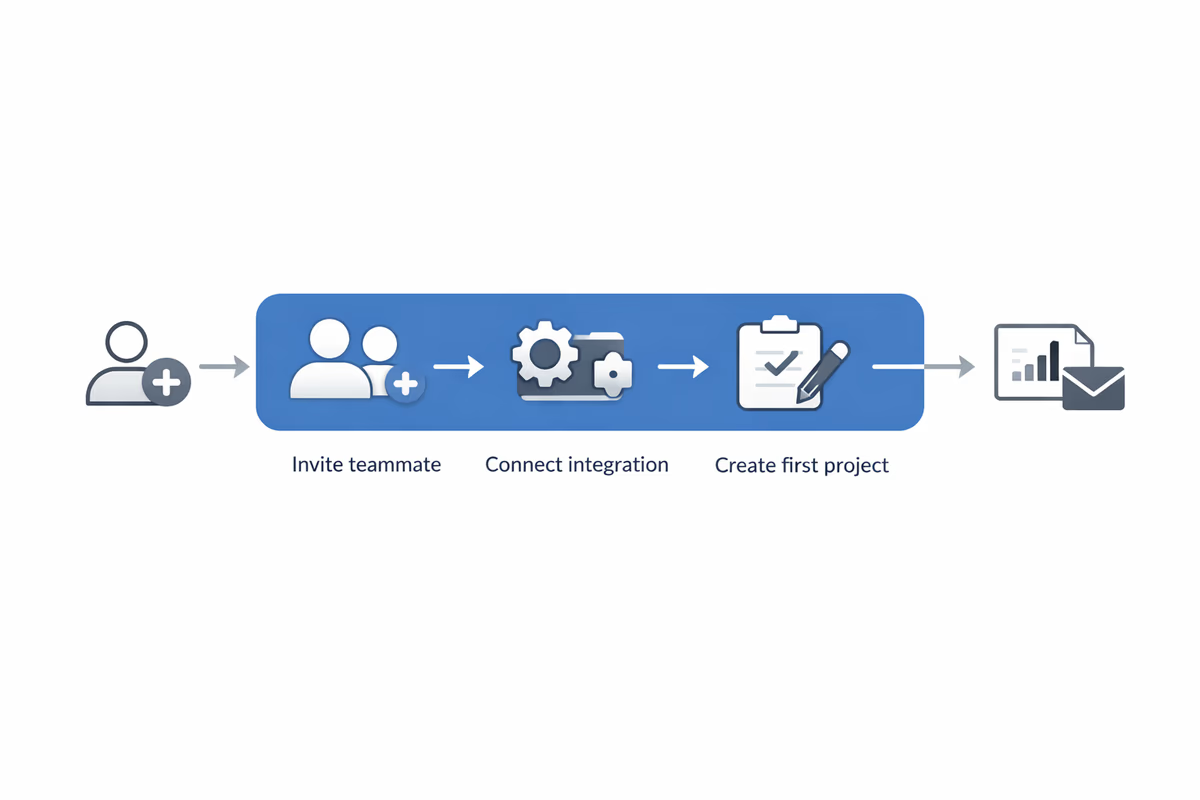
Use a sequence when:
- Setup is required before value (connect data → configure → generate output)
- Collaboration is core (invite → teammate active → shared artifact)
- Your product’s value depends on repetition (3 meaningful uses)
Keep sequences short (2–3 steps). Longer sequences become hard to instrument and optimize.
Example sequence:
- Connected integration
- Imported data successfully
- Created first dashboard viewed at least once
Step 7: Set the right activation window (match your trial reality)
Your activation window should reflect:
- Trial length
- Time needed for setup
- How quickly users can reasonably reach value
Practical starting points:
- 7-day trial → activation window 24–72 hours
- 14-day trial → activation window 3–7 days
- 30-day trial → activation window 7–14 days
Rule of thumb: choose a window that gives you time to intervene. If your trial is 14 days and activation happens on day 12, it’s too late to fix onboarding.
Step 8: Operationalize it (so it actually improves conversion)
Once you pick the best activation definition, use it in three places.
1) Onboarding design
Build your onboarding flow to reduce time-to-activation:
- Guide users to the prerequisites (data connection, permissions, templates)
- Remove optional steps that delay value
- Use just-in-time prompts when users stall before the key action
Tools like User Tourly can help you create targeted in-app flows (checklists, tours, tooltips) that trigger based on user behavior and push users toward the activation milestone.
2) Lifecycle messaging
Segment trial users into:
- Not activated (within window) → nudge + help content + offer support
- Activated → show next-best action, proof, and upgrade prompts
3) Weekly reporting
Track:
- Activation rate (within window)
- Median time to activation
- Trial-to-paid conversion rate for activated vs not activated
If your activation definition is good, improving activation rate should improve conversion rate.
Examples of activation events by B2B SaaS category
Use these as starting templates—then validate with your own data.
Product analytics
- “Installed SDK AND sent first 1,000 events within 72 hours.”
CRM / sales tool
- “Imported at least 200 contacts AND logged 10 activities within 7 days.”
Email marketing
- “Connected sending domain AND sent first campaign to 500+ recipients within 7 days.”
Project management
- “Created a project with 10+ tasks AND assigned tasks to 2+ teammates within 7 days.”
Customer support / helpdesk
- “Connected support inbox AND resolved 5 tickets using workflows/macros within 7 days.”
BI / dashboards
- “Connected data source AND built a dashboard with 3+ charts viewed at least once within 7 days.”
Collaboration / docs
- “Created a doc AND shared with 2 teammates where at least 1 teammate comments or edits within 7 days.”
Security / IT admin
- “Connected identity provider AND enforced at least 1 policy across 10+ users within 14 days.”
The simplest scoring method to pick the winner
If you’re comparing multiple candidates, score each 1–5 on:
- Predictive lift (conversion separation)
- Reach (how many trials can realistically hit it)
- Speed (time-to-activation)
- Controllability (can onboarding influence it?)
Pick the highest total score, then run one onboarding experiment aimed at increasing that activation rate. If activation goes up but conversion doesn’t, your definition wasn’t predictive enough—or you improved activation in a way that didn’t increase real value (which is also a useful finding).
Bottom line
Define activation as the earliest measurable proof of value that strongly separates converters from non-converters. Shortlist candidates, validate them with simple cohorts, avoid purchase-proxy signals, and choose a window that gives you time to intervene. Once you have a predictive activation event, you can design onboarding around it—and finally connect activation improvements to revenue.
FAQ
What if there isn’t a single activation event in our product?
Use a short sequence (2–3 steps) that represents setup → first value → confirmation. Sequences work well for products that require integrations, configuration, or collaboration before users experience value.
How big should the conversion lift be for an activation event to be “good”?
There’s no universal threshold, but a practical starting point is looking for at least ~2x higher trial-to-paid conversion among activated vs not activated accounts, plus enough sample size to trust the difference.
Should activation be measured at the user level or account level?
Match the level at which revenue converts. If you sell to teams/workspaces, measure activation at the account level (and consider collaboration-based criteria). If one person can realize value alone, user-level activation can be sufficient.
Our activation event is predictive but only a small % of trials reach it. What should we do?
Either broaden the definition (reduce thresholds or pick an earlier value milestone) or introduce two tiers: a broad activation event for onboarding optimization and a deeper “power activation” milestone for long-term adoption and expansion.
Table of Contents
- What an activation event is (and what it isn’t)
- Step 1: Start with your conversion goal and unit of analysis
- Your conversion outcome
- Your unit of analysis (user vs account)
- Step 2: Shortlist candidate activation events (10–20 max)
- Where to find candidates
- Candidate event types that work well
- Avoid candidates that are usually false signals
- Step 3: Define each candidate precisely (event + constraints)
- Step 4: Validate predictiveness with a simple cohort table
- Build a 2x2 table for each candidate
- Add “time-to-event” as a second lens
- Step 5: Check for false positives (the 4 common traps)
- Trap 1: The event is basically a purchase step
- Trap 2: The event is driven by sales-assisted motion
- Trap 3: The event is too rare
- Trap 4: The event is too easy
- Step 6: Decide whether activation should be a single event or a sequence
- Step 7: Set the right activation window (match your trial reality)
- Step 8: Operationalize it (so it actually improves conversion)
- 1) Onboarding design
- 2) Lifecycle messaging
- 3) Weekly reporting
- Examples of activation events by B2B SaaS category
- Product analytics
- CRM / sales tool
- Email marketing
- Project management
- Customer support / helpdesk
- BI / dashboards
- Collaboration / docs
- Security / IT admin
- The simplest scoring method to pick the winner
- Bottom line