

How to Launch a B2B SaaS MVP Without Overbuilding
Launch faster by defining your MVP around one painful job-to-be-done and a clear activation moment. Learn how to narrow scope, design a simple onboarding path, instrument the right events, and collect unbiased feedback—while avoiding integrations, edge-case polishing, and features that don’t move activation.
 Ethan M.Product Operations Manager
Launching a B2B SaaS MVP is mostly a discipline problem, not an engineering problem. Overbuilding happens when you treat “MVP” as “small version of the full product” instead of “fastest path to a validated activation moment.”
If you want to ship faster and learn sooner, anchor the MVP around one painful job-to-be-done (JTBD) and one measurable activation moment. Everything else is optional until you can reliably get new accounts to value.
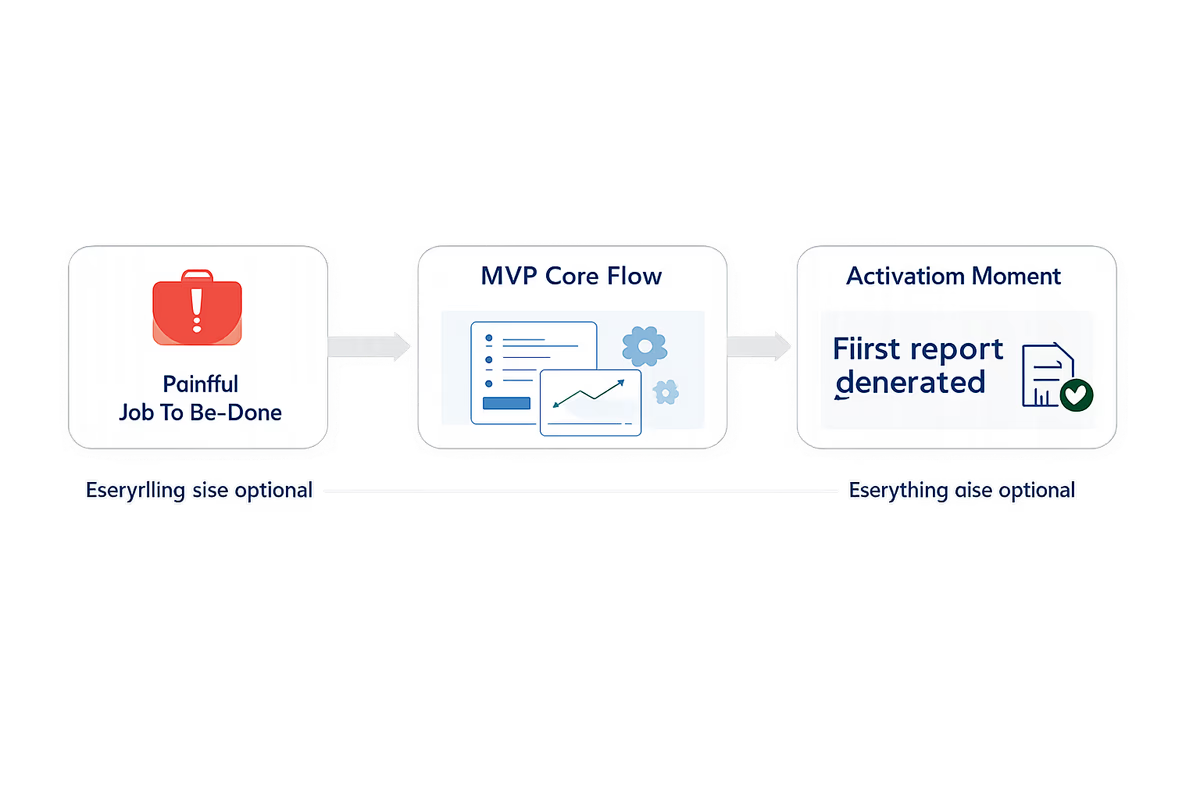
Start with a single painful job-to-be-done
A B2B MVP fails when it tries to serve multiple personas, multiple use cases, and multiple workflows on day one. Your goal is not coverage. Your goal is proof.
Write a one-sentence JTBD
Use this format:
When [situation], I want to [motivation], so I can [outcome].
Example (for a hypothetical onboarding tool):
- When I launch a new product feature, I want to guide users to the “aha” action, so I can increase activation without adding headcount.
Now add two constraints:
- Target persona: who feels this pain most urgently?
- Trigger event: what makes them start searching right now?
If you can’t name a trigger, you’re likely building a “nice-to-have”.
Define the activation moment before you define features
Your MVP scope should be derived from activation, not from a feature wishlist.
What an activation moment is (and isn’t)
Activation is the first time a new account experiences the core promised value.
It is not:
- “Signed up”
- “Invited a teammate” (unless collaboration is the value)
- “Completed onboarding checklist” (unless it maps to value)
It is:
- “Created the first report and shared it”
- “Connected the data source and saw the first insight”
- “Published the first in-app guide and got the first completion”
Make activation measurable and binary
Write it as an event you can track:
Activated = [event] occurs within [time window] after signup
Examples:
- Activated =
first_dashboard_viewedwithin 24 hours of signup - Activated =
first_workflow_publishedwithin 7 days
Pick a time window that matches your sales motion:
- Self-serve/free trial: hours to days
- Sales-assisted: days to weeks (but still define it)
Narrow scope with an “activation-only” feature filter
Once you have the activation moment, you can cut features aggressively.
Use this filter for every feature request
For each candidate feature, answer:
- Does it remove a blocker to activation?
- Does it significantly reduce time-to-value?
- Does it increase the percentage of accounts that reach activation?
If the answer is “no” to all three, it’s not MVP.
Build the thinnest “happy path” that reaches value
Your MVP should support:
- One persona
- One primary use case
- One onboarding route
- One successful outcome
Everything else becomes:
- A manual step (done by your team)
- A workaround (export/import)
- A “not supported yet” message with a path to talk to you
This isn’t being sloppy. It’s protecting learning speed.
Design onboarding backwards from the “aha”
Most MVP onboarding fails because it tries to explain the product instead of getting the user to value.
Map the shortest path to activation
Write the smallest set of steps required to reach the activation event. Typically 3–7 steps.
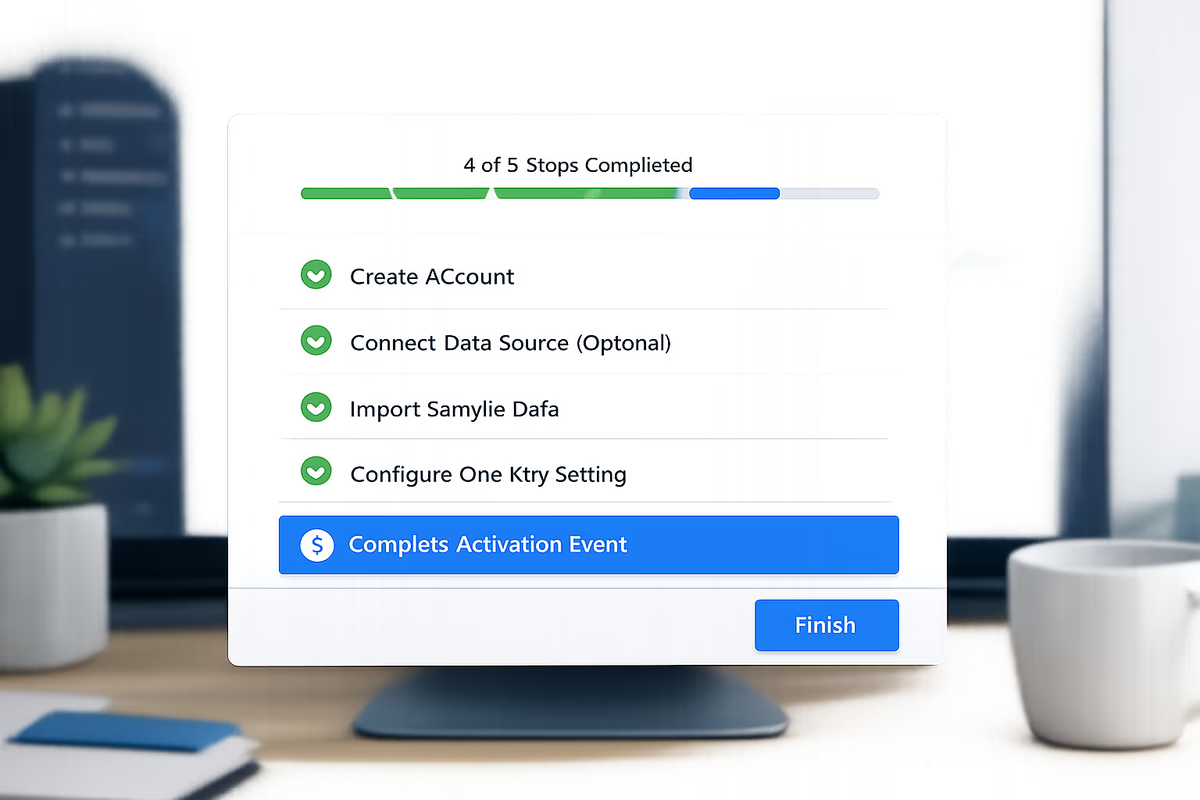
Example structure:
- Choose goal/use case (optional if you can infer)
- Connect required input (data, integration, content)
- Configure the minimum settings
- Trigger the core action
- See the first result
Then remove steps until something breaks.
Prefer a single onboarding path over personalization
Early teams often add branching onboarding (“Are you marketing, product, or CS?”) too soon. Branching multiplies:
- UI states
- edge cases
- analytics complexity
- documentation
Instead:
- Start with one dominant segment.
- Offer one recommended setup.
- Add segmentation only after you see consistent activation and clear drop-off patterns.
Use in-app guidance to reduce explanation overhead
You don’t need a full resource center and long docs to launch. You need just enough guidance to get to the next action.
Practical MVP-friendly guidance:
- One welcome message that sets the expectation (“You’ll be live in ~10 minutes.”)
- One checklist tied to activation steps (not generic)
- Tooltips only where users commonly stall
- A “Need help?” CTA that goes to a real human (calendar or chat)
Tools like User Tourly let you ship these flows without burning engineering cycles on onboarding UI.
Instrument only the events you need to learn
Overbuilding isn’t just features—it’s analytics too. Track what helps you answer: “Are users reaching activation, and where do they drop?”
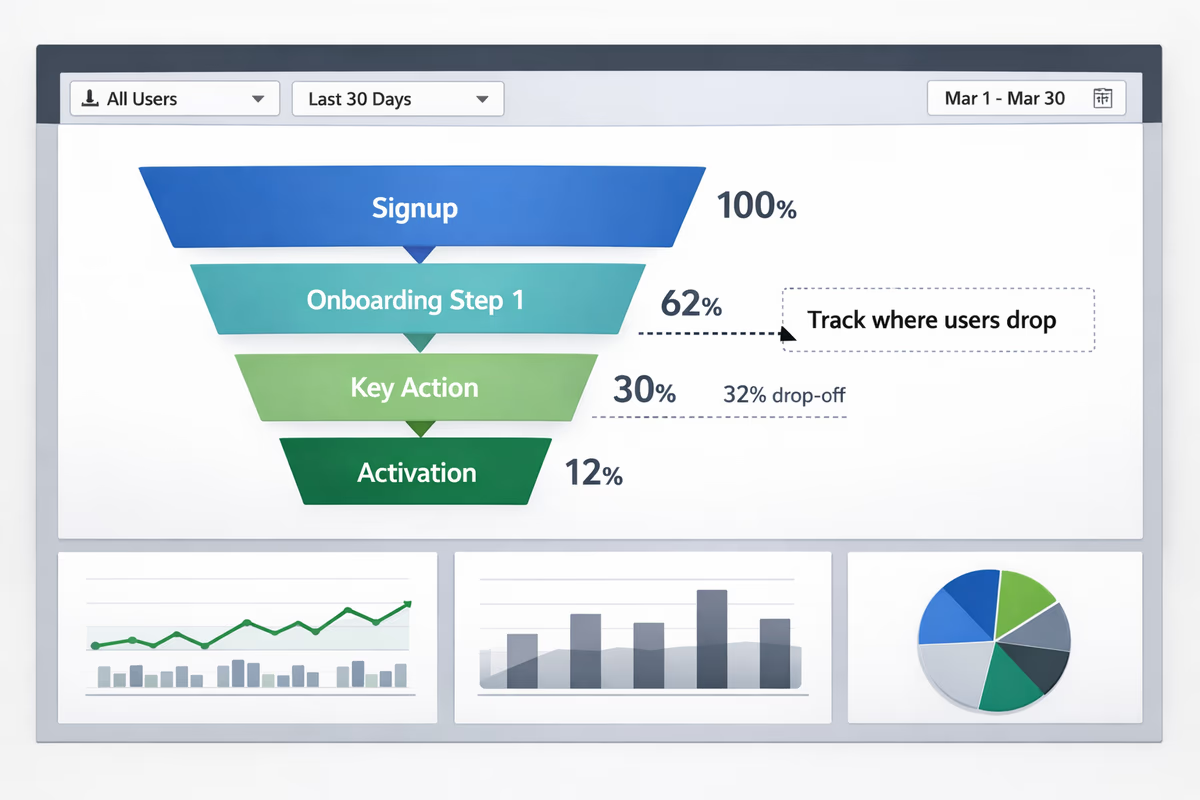
MVP event taxonomy (keep it small)
Track four categories:
-
Acquisition/entry
signup_createdworkspace_created
-
Activation steps (the critical path)
integration_connected(or equivalent)first_project_createdfirst_item_published
-
Activation event (the definition of success)
activated(or the specific event that implies it)
-
Friction signals
error_shownpermission_deniedsetup_abandoned
Capture properties that explain “why”
Add a few properties to make the data actionable:
- persona/role (self-reported or inferred)
- company size band
- acquisition channel
- setup method (manual vs import)
- integration type (if relevant)
Don’t boil the ocean. You can add more later.
Define success metrics for the first 30 days
For an MVP, focus on:
- Activation rate: % of new accounts that hit activation within the time window
- Time-to-value (TTV): median time from signup to activation
- Step conversion: % who move from step N to step N+1 on the critical path
If you can’t improve these, new features won’t save you.
Collect feedback without bias (and without waiting)
MVP feedback is easy to mess up because you’ll hear what people think they want, not what drives activation.
Combine behavioral data + targeted questions
Use product data to decide who to ask and when.
Good moments to ask:
- After activation: “What almost stopped you from getting this live?”
- After a drop-off: “What were you trying to do?” (single open text)
- After a failed step: “What’s missing to complete this?”
Keep surveys short. One question beats five.
Run 10–15 customer interviews with a script
A simple structure:
- What triggered you to look for a solution?
- What did you try before this?
- Walk me through what you did in the product (screen share)
- Where did you hesitate or feel unsure?
- If you could wave a wand, what would make this usable tomorrow?
Avoid leading questions like “Would you use X?” Ask about their workflow and constraints.
Create a “feedback-to-scope” rule
Every request must be translated into:
- the underlying job
- the step it affects
- whether it increases activation rate or reduces TTV
If it doesn’t, park it.
What to avoid: the most common MVP overbuild traps
These are the patterns that slow launches and dilute learning.
1) Too many integrations on day one
Integrations feel like table stakes, but they’re also:
- brittle
- slow to build
- hard to support
MVP approach:
- Support one “must-have” integration for your target persona.
- Offer a CSV import/export or webhook as a temporary bridge.
- Do concierge setup for early accounts.
2) Polishing every edge case
Edge cases multiply QA time and create decision paralysis.
MVP approach:
- Handle the happy path extremely well.
- Add clear guardrails: validations, defaults, and “not supported yet” messaging.
- Log edge-case occurrences so you know what’s actually common.
3) Features that don’t improve activation
Dashboards, themes, advanced permissions, and complex templates are often “later” features.
MVP approach:
- If a feature doesn’t remove friction on the activation path, don’t build it.
- If it’s demanded by one prospect, treat it as a paid pilot requirement, not a roadmap item.
4) Onboarding that explains instead of guides
Long tours and documentation are a substitute for product clarity.
MVP approach:
- Show users the next step, not every feature.
- Use progressive disclosure: reveal complexity after activation.
A practical MVP launch checklist (activation-first)
Use this to decide if you’re ready to ship.
Product
- [ ] One persona and one primary use case
- [ ] A written activation definition (event + time window)
- [ ] A working happy path from signup to activation
- [ ] Clear defaults and guardrails (no “blank slate confusion”)
Onboarding
- [ ] A single recommended setup path
- [ ] Minimal in-app guidance tied to activation steps
- [ ] One human-help escape hatch (book a call/chat)
Analytics
- [ ] Events for each activation step + activation event
- [ ] Drop-off visibility between steps
- [ ] TTV and activation rate tracked weekly
Feedback
- [ ] 10–15 interview slots scheduled with target users
- [ ] One-question prompts at key moments (post-activation, post-drop)
- [ ] A rule for translating feedback into activation impact
Ship, learn, and iterate on the path—not the perimeter
A strong B2B SaaS MVP isn’t the smallest product you can build. It’s the smallest product that reliably delivers value to a specific buyer.
If you keep activation and time-to-value as your north star, scope decisions get simpler:
- Build what gets users to the “aha.”
- Guide them there with a straightforward onboarding flow.
- Measure the path.
- Talk to users at the moments that matter.
That’s how you launch without overbuilding—and how you earn the right to expand the product later.
FAQ
How do I choose an activation moment for a B2B SaaS MVP?
Pick the first measurable action that proves the user received the core promised value (not just created an account). Define it as an event (e.g., “first workflow published”) and add a time window (e.g., within 7 days of signup).
How many features should a B2B SaaS MVP include?
Only the features required to complete the happy path to activation for one persona and one use case. If a feature doesn’t remove an activation blocker, reduce time-to-value, or increase activation rate, it’s not MVP.
What metrics matter most right after MVP launch?
Activation rate, median time-to-value, and step-to-step conversion on the activation path. These tell you whether the product delivers value quickly and where new accounts get stuck.
Should I build integrations in my MVP?
Build only the single integration that’s mandatory for your target persona to reach activation. For everything else, use temporary bridges like CSV import/export, webhooks, or concierge setup until activation is consistent.
Table of Contents
- Start with a single painful job-to-be-done
- Write a one-sentence JTBD
- Define the activation moment before you define features
- What an activation moment is (and isn’t)
- Make activation measurable and binary
- Narrow scope with an “activation-only” feature filter
- Use this filter for every feature request
- Build the thinnest “happy path” that reaches value
- Design onboarding backwards from the “aha”
- Map the shortest path to activation
- Prefer a single onboarding path over personalization
- Use in-app guidance to reduce explanation overhead
- Instrument only the events you need to learn
- MVP event taxonomy (keep it small)
- Capture properties that explain “why”
- Define success metrics for the first 30 days
- Collect feedback without bias (and without waiting)
- Combine behavioral data + targeted questions
- Run 10–15 customer interviews with a script
- Create a “feedback-to-scope” rule
- What to avoid: the most common MVP overbuild traps
- 1) Too many integrations on day one
- 2) Polishing every edge case
- 3) Features that don’t improve activation
- 4) Onboarding that explains instead of guides
- A practical MVP launch checklist (activation-first)
- Product
- Onboarding
- Analytics
- Feedback
- Ship, learn, and iterate on the path—not the perimeter