

Time to Value: The Metric That Determines SaaS Growth
Time to Value (TTV) measures how quickly users reach their first meaningful outcome. Learn how to define, measure, and reduce TTV with practical onboarding, activation, and product changes that improve conversion and retention.
 Emma C.Head of Growth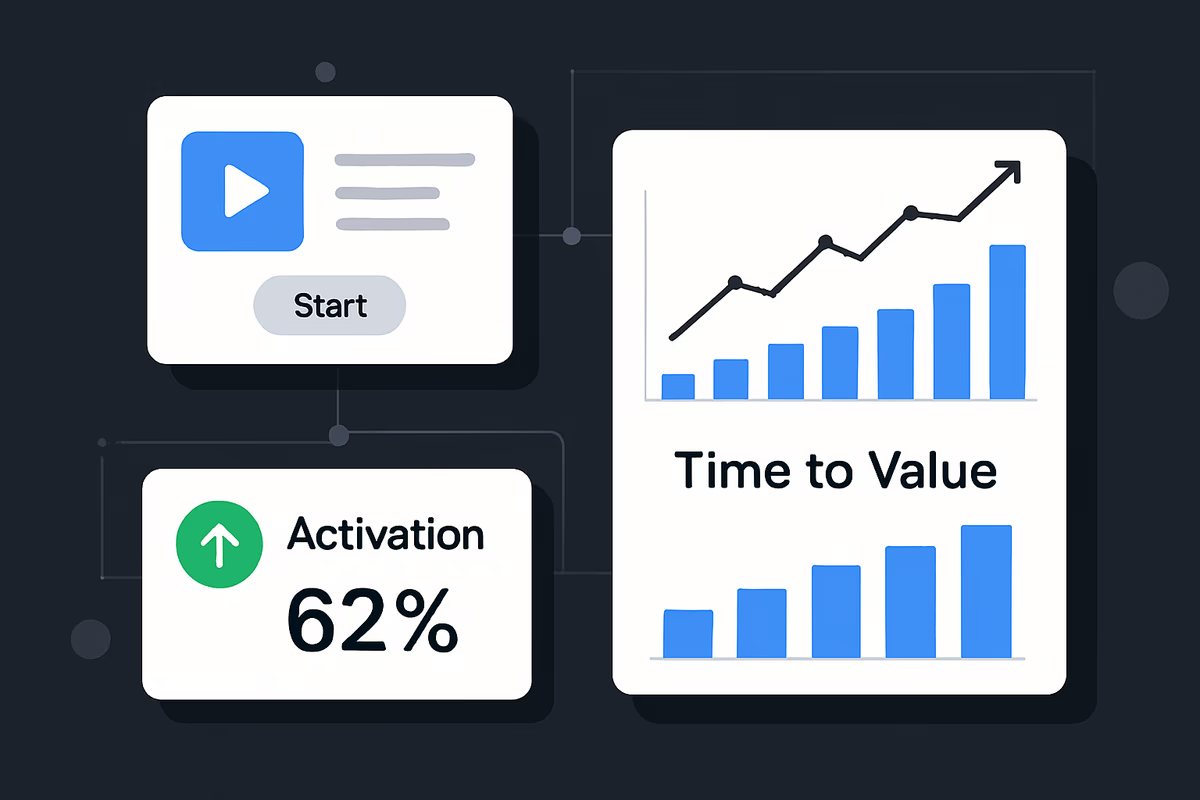
If users don’t experience value fast, they don’t stick around long enough to convert, adopt, or renew. That’s why Time to Value (TTV) is one of the most practical SaaS metrics you can improve—because it directly impacts activation rate, trial-to-paid conversion, support load, and retention.
This guide breaks down how to define TTV correctly, how to measure it without getting lost in vanity events, and how to reduce it with changes you can actually ship.
What Time to Value (TTV) means (and what it doesn’t)
Time to Value is the time between a user’s starting point (usually signup) and the moment they achieve their first meaningful outcome.
TTV is not:
- Time to first login
- Time to first click
- Time to finish a product tour
Those are activity metrics. TTV is an outcome metric.
The 3 common TTV definitions
You’ll see TTV defined in a few ways. Pick the one that matches your business model and user journey.
- Time to First Value (TTFV): time to the first meaningful outcome (best for trials and PLG)
- Time to Basic Value: time to a “minimum viable success” outcome (useful for complex products)
- Time to Full Value: time to the outcome that correlates with long-term retention (useful for expansion and enterprise)
Most SaaS teams should start with TTFV because it’s the strongest lever for activation and early retention.
Why TTV determines SaaS growth
Growth isn’t just acquisition. It’s what happens after acquisition.
When TTV is long:
- Users drop off before reaching activation
- Trial users run out of time
- New customers need more support to get started
- Stakeholders don’t see ROI, increasing churn risk
When TTV is short:
- More users reach activation
- More accounts convert from trial to paid
- Users adopt core features sooner
- Retention improves because value is experienced early and repeatedly
A simple way to think about it:
Lower TTV increases the percentage of users who reach the “aha moment” before motivation fades.
Step 1: Define “value” in a way you can measure
TTV only works when “value” is clearly defined.
How to find your first value moment
Look for the earliest point where users can say: “This is working for me.”
Good first value moments are:
- Observable in product analytics
- Closely tied to the product’s promise
- Achievable in one session (or at least within a day)
Examples (adapt to your product):
- Project management: created a project and assigned a task
- Email marketing: imported contacts and sent a campaign
- Analytics: installed the tracking snippet and saw first events
- Sales CRM: added first lead and logged an activity
Turn “value” into an activation event
Define a single activation event or milestone that represents first value.
A practical format:
- Activation = user completes Event A + Event B within X hours
This avoids false positives (e.g., “created a project” but never used it).
Step 2: Measure TTV the right way
Choose a start point
Most teams use:
- Signup timestamp (best for PLG and trials)
- First login (use if signup is separate from first product access)
- Workspace created (use if users can sign up but delay setup)
Pick one and document it. Consistency matters more than perfection.
Calculate TTV
For each user (or account), calculate:
- TTV = timestamp(first value) − timestamp(start point)
Then report:
- Median TTV (more reliable than average)
- TTV distribution (P25/P50/P75) to see how many users struggle
- % of users reaching value within target time (e.g., within 15 minutes / 1 day)
Segment your TTV (this is where the insight is)
Overall TTV hides problems. Segment by:
- Acquisition channel (paid search vs. organic vs. partner)
- Persona/job-to-be-done (marketer vs. ops vs. founder)
- Company size (SMB vs. mid-market)
- Use case selected at signup
- Device type (mobile vs. desktop)
You’re looking for segments with:
- High intent but long TTV
- High volume but low activation
Those are your biggest growth opportunities.
Step 3: Diagnose where time is being lost
TTV is the output. To reduce it, you need to see the bottlenecks.
Map the “value path”
List the minimum steps to reach first value.
Example:
- Signup
- Create workspace
- Connect integration
- Import data
- Configure first workflow
- Run workflow (first value)
Then ask two questions for each step:
- Does the user understand why this step matters?
- Is the step necessary right now, or can it be delayed?
Use drop-off and time-between-steps analysis
Look at:
- Step-to-step conversion (where users abandon)
- Median time between key events (where users stall)
Common friction points:
- Too many required fields in setup
- Integration requirements before users can “see anything”
- Confusing terminology (users don’t know what to do next)
- Empty states that don’t guide action
- Asking for too much commitment too early (inviting team, billing, etc.)
Step 4: Reduce TTV with product and onboarding tactics
Reducing TTV usually comes down to removing steps, clarifying next actions, and giving users a faster path to a visible outcome.
1) Shorten the path to first value
Tactics:
- Make “quick start” the default path
- Defer advanced configuration until after first value
- Pre-fill settings with sensible defaults
- Offer templates by use case (so users start from “almost done”)
Rule of thumb: if a step doesn’t directly enable first value, try to move it later.
2) Improve first session guidance (without overwhelming users)
Your first session experience should answer:
- What do I do first?
- What outcome will I get?
- How long will it take?
Practical approaches:
- A short welcome screen that sets expectations and asks one segmentation question (use case)
- A checklist with 3–5 steps max, tied to outcomes
- Contextual tooltips only at the moment of need
- Progress feedback (“2 steps away from your first report”)
The goal is not to show features. It’s to get users to value faster.
3) Fix empty states so they drive action
Empty states are often where TTV dies.
Replace “Nothing here yet” with:
- A clear action (“Import your contacts to send your first campaign”)
- A primary CTA
- A sample dataset or demo content option
- A link to the fastest setup path
If users can’t see a path forward, they leave.
4) Use “instant value” wherever possible
If your product depends on data, integrations, or setup, give users something valuable before the full setup is complete.
Examples:
- Show a preview dashboard using sample data
- Let users explore templates without connecting tools
- Provide a guided “test run” workflow
This reduces perceived effort and keeps users engaged long enough to complete setup.
5) Remove or delay friction-heavy asks
Common TTV killers:
- Mandatory team invites
- Long onboarding forms
- Early paywalls before value is experienced
- Requiring an integration before users understand the payoff
If you must ask for something early, explain the benefit in plain language and provide an alternative path.
Step 5: Set a TTV target and run experiments
Pick a target that matches intent
A realistic TTV target depends on your product complexity and user motivation.
- High-intent, simple products: minutes
- Moderate complexity: same day
- Complex workflows: 1–7 days (but still aim for an early “first win”)
Define two targets:
- Target TTFV (first value)
- Target activation rate within X time (e.g., 40% activated within 24 hours)
Run TTV-focused experiments
Good experiment ideas:
- New onboarding checklist vs. old flow
- Template-first onboarding vs. blank state
- Integration later vs. integration required upfront
- Use-case question at signup vs. no segmentation
- Interactive walkthrough for one critical workflow
Measure:
- TTV (median and distribution)
- Activation rate
- Trial-to-paid conversion
- Early retention (Day 7/Day 14)
Don’t ship changes that reduce TTV but hurt long-term retention. Watch both.
Common mistakes when optimizing TTV
Optimizing for speed instead of value
A faster path to a meaningless event doesn’t help. Tie TTV to outcomes that correlate with retention.
One-size-fits-all onboarding
Different personas have different value paths. If you serve multiple use cases, segment early.
Measuring only “activated” vs. “not activated”
Binary activation hides the story. Track time-to-event and where users stall.
Ignoring account-level TTV in B2B
In B2B, value often depends on the workspace/account, not just a single user. Track both user and account TTV when relevant.
A simple TTV optimization checklist
Use this when you need a practical starting point:
- Define first value as an observable outcome (not a click)
- Instrument the key events that represent the value path
- Track median TTV and P75 (your “strugglers”)
- Segment TTV by persona, channel, and use case
- Fix the biggest stall point first (not the first step)
- Add contextual guidance at the moment of confusion
- Improve empty states with a clear next action
- Use templates/defaults to reduce setup time
- Run experiments and monitor activation + retention
The takeaway
Time to Value is a growth metric because it controls how many users reach meaningful outcomes before they churn or disengage. If you can define first value clearly, measure TTV by segment, and systematically remove friction in the value path, you’ll improve activation and retention—without needing more top-of-funnel spend.
Focus on one thing: help users experience a real win as early as possible, then make it repeatable.
FAQ
What is a good Time to Value (TTV) for SaaS?
A “good” TTV depends on product complexity and user intent. Simple PLG tools often target minutes to first value, moderate workflow tools aim for same-day value, and complex platforms may take days. The key is setting a target that matches your promise and then increasing the percentage of users who reach first value within that window.
How do you measure Time to Value accurately?
Start by defining a measurable first value milestone (an outcome, not an action). Then calculate TTV as the time between a consistent start point (e.g., signup) and the timestamp of that milestone. Report median TTV, distribution (P25/P50/P75), and segment results by persona, channel, and use case.
What’s the difference between Time to Value and activation?
Activation is typically a milestone (did the user reach the key outcome or not). Time to Value measures how long it takes to reach that milestone. You want both: a high activation rate and a short TTV, especially for trials and self-serve onboarding.
What are the fastest ways to reduce TTV?
The highest-impact tactics are usually: shorten the setup path (delay non-essential steps), use templates and defaults, improve empty states with clear next actions, add contextual in-app guidance for critical steps, and provide instant value (sample data or previews) so users see benefits before full setup is complete.
Table of Contents
- What Time to Value (TTV) means (and what it doesn’t)
- The 3 common TTV definitions
- Why TTV determines SaaS growth
- Step 1: Define “value” in a way you can measure
- How to find your first value moment
- Turn “value” into an activation event
- Step 2: Measure TTV the right way
- Choose a start point
- Calculate TTV
- Segment your TTV (this is where the insight is)
- Step 3: Diagnose where time is being lost
- Map the “value path”
- Use drop-off and time-between-steps analysis
- Step 4: Reduce TTV with product and onboarding tactics
- 1) Shorten the path to first value
- 2) Improve first session guidance (without overwhelming users)
- 3) Fix empty states so they drive action
- 4) Use “instant value” wherever possible
- 5) Remove or delay friction-heavy asks
- Step 5: Set a TTV target and run experiments
- Pick a target that matches intent
- Run TTV-focused experiments
- Common mistakes when optimizing TTV
- Optimizing for speed instead of value
- One-size-fits-all onboarding
- Measuring only “activated” vs. “not activated”
- Ignoring account-level TTV in B2B
- A simple TTV optimization checklist
- The takeaway